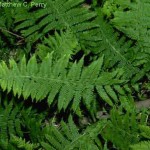
Native Thelypteris noveboracensis is common in sunny patches caused by canopy gaps in mixed woodlands, near vernal seeps, at the edge of swamps, and along streams. Once soil pH levels decline below 4.1, this fern can become a dominant understory species. In such situations, it may outcompete the seedlings of certain tree species, some of which […]
posted on April 30, 2015 by
Fern, Interrupted (Osmunda Claytoniana)
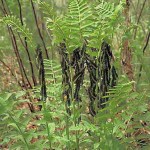
Native Osmunda claytoniana is found in humid zones, mostly in forests, but also in more open habitats and biomes, although rarely in bogs. The interrupted fern is often found alongside ostrich, cinnamon and sensitive ferns. Fruiting bodies are produced on the lower portion of the fronds in between the pinnae (leaf blades), giving this distinctive fern its name. In spring, the newly emerging silvery-white […]
posted on April 30, 2015 by
Fern, Hay scented (Denstaedtia Punctilobula)
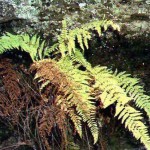
Native The Hay Scented Fern’s scientific name is Denstaedtia Punctilobula. This fern is very unique. It is a very common fern that grows in mass colonies. It literally looks like a beautiful green carpet. The Hay Scented Fern can be invasive. It does not do very well in gardens with other flowers or ground covers. Dennstaedtia punctilobula can exhibit […]
posted on April 30, 2015 by
Fern, Bracken (Pterdium Aquilinum)
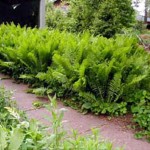
Native Pteridium aquilinum (bracken, brake or common bracken), also known as “eagle fern,” is a species of fern occurring in temperate and subtropical regions in both hemispheres. The extreme lightness of its spores has led to its global distribution. Common bracken is a herbaceous perennial plant, deciduous in winter. The large, roughly triangular fronds are produced singly, arising upwards from an underground rhizome, and grow […]
posted on April 30, 2015 by
Fern, Beech (Phegopteris Connectilis)
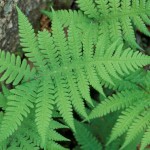
Native In the typical form (triploid), the lowest pair of leaflets are usually out of plane with the remaining leaflets and typically are projected downward and form an angle of 45–120 degrees between them. In the tall form (tetraploid), the lowest pair of leaflets usually are ± in plane with the remaining leaflets being only slightly projected downward and […]